COMPLETE
GRE & Multicast over GRE
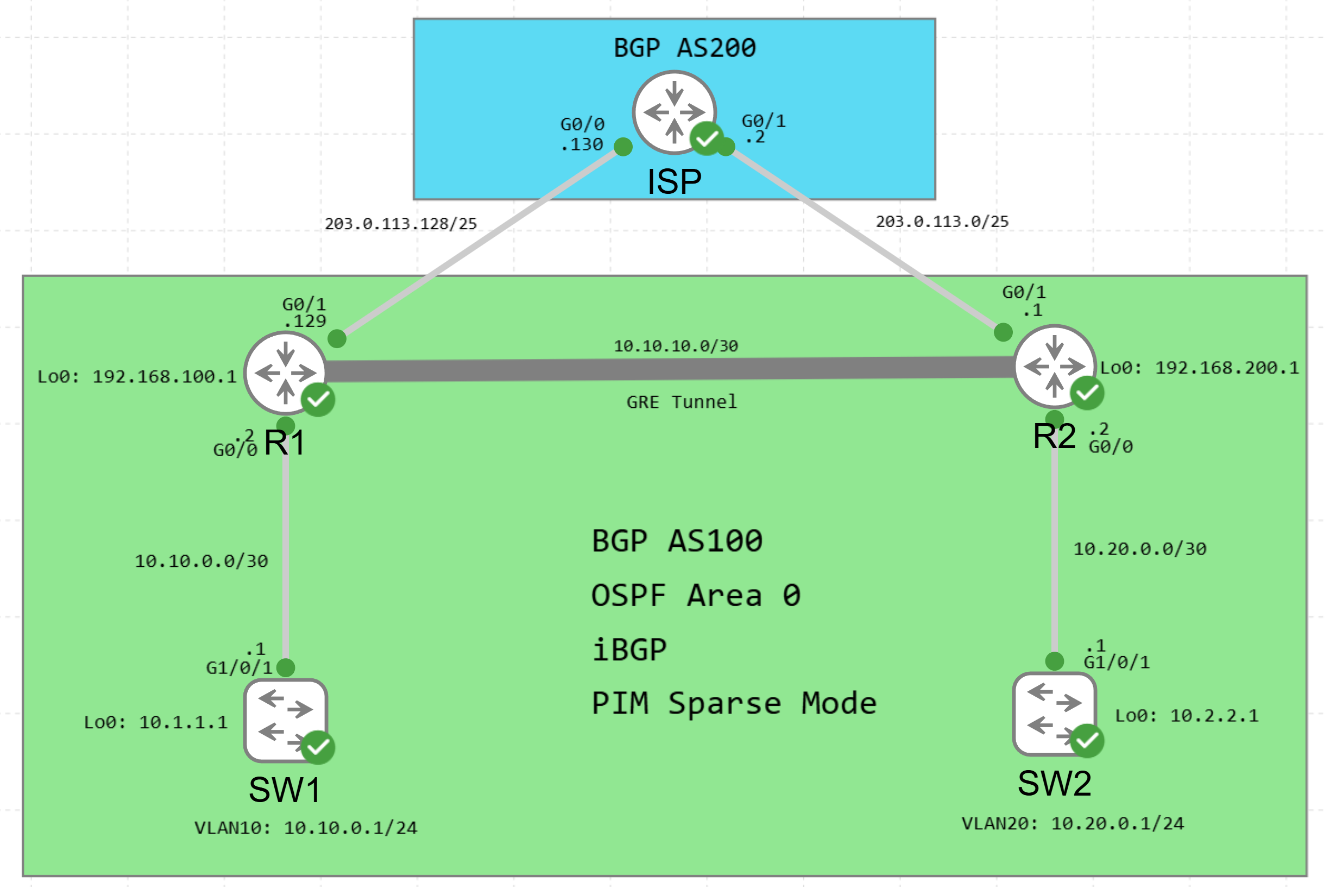
Two-site topology with a GRE tunnel between R1 and R2 over a simulated ISP. Runs OSPF area 0 internally, eBGP to the ISP, iBGP between R1 and R2 via loopbacks, and PIM sparse mode with a static RP for multicast forwarding over the tunnel.
COVERAGE
GRE Tunnel
- Tunnel source GigabitEthernet0/1 on both R1 and R2
- Tunnel destination - ISP-facing physical IPs
- 10.10.10.0/30 tunnel addressing
- OSPF P2P network type on tunnel (default)
Routing - OSPF & BGP
- OSPF area 0 across R1, R2, SW1, SW2
- eBGP to ISP (AS200) from both R1 and R2
- iBGP between R1 and R2 using loopbacks
- update-source Loopback0 + next-hop-self
- Default route from ISP via default-originate
Multicast - PIM
- ip multicast-routing on R1 and R2
- ip pim sparse-mode on all interfaces including Tunnel0
- Static RP: ip pim rp-address 192.168.100.1
- PIM neighbor over GRE tunnel verified
Addressing
- R1 Lo0: 192.168.100.1 - PIM RP
- R2 Lo0: 192.168.200.1
- SW1 Lo0: 10.1.1.1, VLAN10: 10.10.0.1/24
- SW2 Lo0: 10.2.2.1, VLAN20: 10.20.0.1/24
- ISP: 203.0.113.128/25 and 203.0.113.0/25
NOTES
Built to cover GRE tunneling, multi-protocol routing, and multicast in a single cohesive topology. The GRE tunnel provides the site-to-site overlay, OSPF runs internally over it, and PIM sparse mode with a static RP on R1's loopback enables multicast forwarding across the tunnel. The ISP advertises a default route into both eBGP sessions which gets redistributed internally via OSPF default-information originate.